FinTech: We’re just getting started

Global FinTech investment in 2017 was unprecedented with $16.6B of capital (+20% compared to 2016) deployed across 1,128 deals. Despite this, some have argued that FinTech’s days are numbered and that it is less clear how much opportunity still remains for future innovation. Proponents of this line of thought argue that most traditional financial services have already been unbundled and that large startups that dominate areas like payments, lending, and investing have even begun to re-bundle services. Moreover, despite the uptick in investment into the sector, the early-stage portion of overall financing dropped to a 5-year low which has further supported the belief that most of the innovation in FinTech has already happened.

At Matrix, we believe that we are still in the early innings of the financial services disruption. While FinTech startups have done very well in the last decade, there is still room for more great companies to be built. As a follow-up to our previous article where we introduced the Matrix FinTech Index, we have put together a corollary to that piece where we specify 7 tailwinds that have powered FinTech innovation for the last 10 years, discuss key drivers for future innovation, and identify the subcategories we believe are most promising.

Review of 7 important tailwinds for innovation in FinTech the last 10 years

  • Mobile has been leveraged as an enabler: Companies like Squareleveraged mobile as a way to reduce the cost of doing business for merchants by allowing for new features like secure payments via mobile applications.
  • The financial crisis created unmet demand: Incumbent’s unwillingness to lend to credit poor individuals and high-risk SMBs created a window of opportunity for companies like Lending Club and OnDeck to fulfill this unmet demand.
  • The payments infrastructure opened up to developers: APIs and developer tools made available by companies like Braintree and Stripeallowed developers to integrate payment processing into their websites without the need to maintain a merchant account.
  • Online banking penetration unlocked important customer data: Deeper penetration of online banking has made it possible for companies like Yodlee to allow users to see all their banking information on one screen and others like Credit Karma to provide credit monitoring services.
  • Core financial services have been unbundled: Many sub-segments traditionally handled solely by the banks have been unbundled. For example, SoFi is helping with borrowing, Xoom with money transfers and Mint with financial management.
  • The cloud provided a new distribution channel to serve SMBs: Companies like Kabbage, which provides loans to SMBs, can now justify serving lower life time value customers like SMBs due to the lower customer acquisition costs associated with the cloud.
  • Digital disintermediation provided greater value to consumers: Companies like WealthfrontBetterment and Robinhood all reduce the fees charged by brokerages and traditional investment managers providing greater alpha to retail investors.

Key drivers for innovation in the next 10 years

Many of these 7 trends will continue to play a role in FinTech innovation moving forward. But we have identified 3 additional drivers for innovation in FinTech going forward.

1. Incumbent failures are really coming into focus.

Traditional financial institutions are anachronistic. They serve their customers with antiquated products and are often slow to innovate due to both their size and regulatory burdens. Moreover, financial products have historically not been customer-centric, as banks devote most of their resources to optimizing their data and analysis and boosting their bottom line. Consequently, incumbents in financial services have largely failed to meet the needs of consumers, and the emergence of FinTech has put their shortcomings under the spotlight.
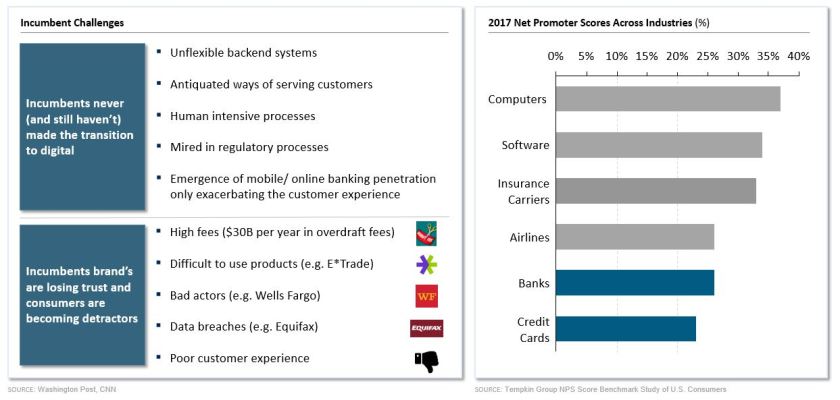
Figure 1

While financial services as an industry has been notorious for low consumer trust levels, consumer trust has plunged even further in the wake of fraud, scandals, and data breaches (e.g. Wells Fargo and Equifax). Additionally, poor customer experience has left consumers with limited loyalty to their financial services providers.

2. Millennials are emerging as the new source of spending power.

Millennials are the largest generation in American history consisting of over 70 million people born between 1980 and 2000. Millennials are digital-first users who grew up distrustful of banks and are generally more inclined to try FinTech applications. Furthermore, while traditional financial services has focused on large pools of wealth characteristic of older generations, FinTech innovation is making financial services and products much more accessible to younger generations.
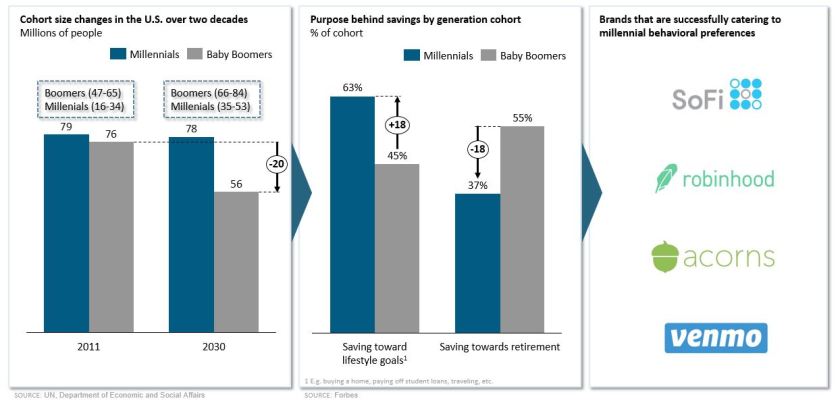
Figure 2

3. Due to the transition of profit pools, incumbents are going to become a lot more acquisitive in the coming months.

Incumbents have begun to acquire FinTech companies as a means to compete against innovative startups and other acquisitive incumbents. Many of the acquisitions so far have been centered around automation of basic tasks. In the last 5 years, 18 FinTech startups have been acquired by banks, with 8 acquisitions occurring since the beginning of 2017. We believe that there is much more opportunity and incentive to acquire — especially for technologies that go beyond automation.
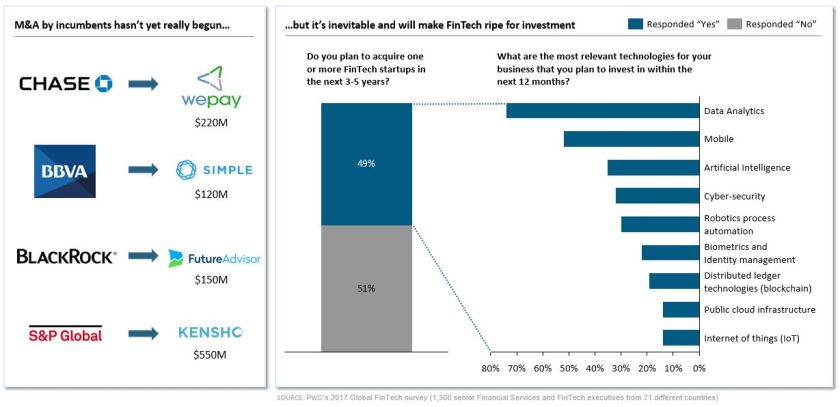
Figure 3

5 subcategories we are most excited about

Ultimately we believe the incumbents will continue to lose ground to the FinTechs and that there is plenty of opportunity for entrepreneurs to build enduring companies in the sector. Great companies will certainly be built across the entire financial services industry, but here are a few sub-categories within FinTech that we think are particularly exciting:

  • Payments: Even with all the innovation to date in payments, there continue to be pain points throughout the category and many customer demographics remain underserved. In order to be successful in this category, new entrants will need to build on-top of existing payment rails, serve large TAMs and go after new use cases.
  • Investing / wealth management: Despite recent innovation by players like WealthfrontBettermentRobinhood and others, wealth management remains dominated by the incumbents. This reality makes the category a ripe one for entrepreneurs as there are large TAMs, poor customer experiences and a new generation (i.e. millennials) that have unmet needs. Success here will require intuitive design, low fees and efficient customer acquisition.
  • Infrastructure Apps: Financial institutions suffer from bloated cost structures in the middle and back office for tasks like fraud/ risk management, collections, invoice management and customer support. There’s an opportunity for entrepreneurs to provide software tools that reduce costs and allow for more efficient work flows if they can manage the lengthy sales cycles and procurement processes.
  • SMB tools: Companies like Gusto and Namely, have begun to serve SMBs in areas like payroll and benefits administration. Even so, SMBs remain largely underserved compared to larger enterprises. FinTech companies that can acquire SMBs efficiently and provide enterprise-level experiences will be able to generate enough value to their customers to create large outcomes.
  • B2B Lending tools: On the consumer side, lending has become pretty crowded with some of the winners already declared. But on the enterprise side, the category is very ripe. The opportunity for entrepreneurs is in leveraging data at cloud scale combined with advances in machine learning to allow enterprises to better assess borrower risk and drive higher yield.

The author would like to thank Sreyas Misra for his contributions to this piece.
California, I’m coming home

After a decade on the east coast, I’m excited to announce that I’ve returned back to the west coast as an early stage investor with Matrix Partners in the Bay Area. I’m beyond excited to be joining this incredible team to help invest and support the next wave of bold entrepreneurs.

The last ten years in Ithaca and then NYC have been transformative. I’m lucky to have had the opportunity to learn at a couple of great schools and then learn some more at the first few stops on my career journey. Most recently, while working in the High-Tech and Fast Growth Tech practices as McKinsey, I worked with a dozen companies on everything from marketing & sales to customer success to go-to-market strategy. It was rapid-fire exposure to many of the key challenges founders and management teams face in the early stages and as they scale.

While I enjoyed this experience immensely, I found myself wanting to work with founders earlier in their journey and over much longer periods of time. Being there with the entrepreneur as an advocate through both good times and bad is what makes a successful outcome all the more rewarding. So when the opportunity at Matrix opened up, I knew I had to go for it.

Matrix Partners has been quietly but consistently racking up wins for four decades over ten funds—a deep track record that few firms in the venture business can claim to have. In the early days, Matrix invested in the likes of Apple, SanDisk and FedEx. More recent investments include: Acacia Communications, HubSpot, Oculus and Zendesk. And there are some great companies in the portfolio well on their way like Lever, Namely, Quora and Activehours, among many others. The firm is also very well positioned internationally with presences in both India and China.

More important than this track record though, the team at Matrix is full of high quality people. The group has a diverse set of skills and a wide range of expertise (check them out here), but they share one thing in common: a deep commitment to supporting the visionary entrepreneurs who join the Matrix family all the way. And they do this with integrity, class and style.

I’m pumped to be joining this team, making the move back to CA and beginning to meet the founders and operators building the companies of tomorrow. If you’re embarking on this journey – let’s chat!

You can find me on LinkedIn, Twitter and Quora. I also actively write about technology, startups and investing on my personal blog here

Core & Emerging Platforms as we Move into 2017

Innovation at the platform level (whether it be improved hardware, changes in infrastructure or new ecosystems) has always led to new opportunity at the application level for both entrepreneurs and the investors that back them. As 2016 winds down and we look ahead to 2017, it’s as good a time as any to take stock of the innovation we’ve seen at the platform level in the last few years and the trends in tech that will drive new opportunity in application software.

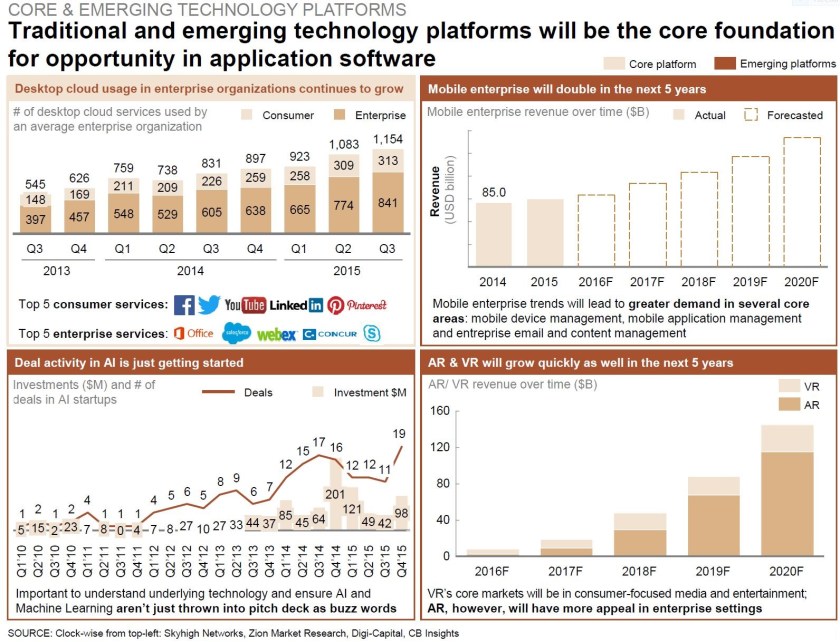
More specifically, I see four core and emerging trends that will continue to dictate opportunity in B2B software: (1) continued dominance of cloud, (2) acceleration of mobile enterprise, (3) increased attention to AI (more specifically machine learning) and (4) the rise of AR & VR – particularly AR in the B2B setting. The figure below provides an overview that will be explained in further detail below:

tech-platforms

(1) Continued dominance of cloud

This is an “old” one but a good one. Of the four platform trends this is the most established one and has produced the most opportunity to-date.

From a horizontal perspective, the cloud has penetrated (though not yet dominated) every function within the enterprise. Salesforce is the prevalent choice for most in the sales / CRM functions. Companies like Workday, Cornerstone and SuccessFactors have gained real traction within HR. Eloqua, ExactTarget and Marketo are widely used marketing tools. NetSuite has a strong presence in ERP while Zendesk is a strong force in customer success. And there are many other more recent horizontal SaaS companies that have made big waves: Slack, Stripe, DocuSign and DropBox are just a few of many that had big years in 2016. And there are many more opportunities remaining in relatively untouched areas like: sales ops, SMB-focused HR tools, inventory management, market intelligence and customer care analytics.

Vertical software, is still very much in its infancy. There have certainly been some early winners like Veeva (life sciences), RealPage (real estate) and Fleetmatics (fleet management), but there are many more industry cloud winners to come. Industries like manufacturing, construction, logistics, agriculture, oil and gas and others have slowly begun moving to the cloud after remaining cloud-allergic for many years. 2017 will be a big year for many of these industries and the vertical-focused, category-winners that reshape them.

(2) Acceleration of mobile enterprise

Aggregate mobile enterprise revenue in 2016 was just under $100B –pretty solid for a platform that didn’t exist 10 years ago. However, this one is also just getting started. Forecasts show this number doubling by 2020 (and I wouldn’t be surprised if the growth rate is higher than that). Part of this growth is fueled by increased vertical software opportunities. Procore is a great example of a company delivering a vertical specific solution (in construction) via mobile enterprise. Industries like education, insurance and real-estate will soon follow.

(3) Increased attention to AI  

2016 really marked THE year when AI (or more accurately, machine learning) really came into focus in the startup and venture community. As seen in the figure above, deals done and investment dollars poured into the sector have grown exponentially in the last 2-3 years. In that time, AI has done a few interesting things:

  • It has re-opened the door in a real way to more horizontal software opportunities giving rise to the “disruption of the disruptors.” Suddenly, machine intelligence has allowed for greater insights and better products and services that opened the door to new entrants looking to enter horizontal spaces.
  • It has allowed for more focused solutions that really benefit from machine learning applied to large data sets to flourish. Little Bird (a market intelligence and data analytics company based out of Oregon) that was recently acquired by Sprinklr is a good example. AI powered point solutions like Little Bird, once bolted onto larger platforms (like Sprinklr’s social media management platform) can exponentially increase the utility to their enterprise customers.
  • It has brought back IBM’s relevance among innovators and early stage companies. Ironically, rightly or wrongly, IBM’s Watson is the most common machine associated with machine learning. Whether IBM is able to harness the potential of AI remains to be seen, but the company attempts to be mounting a bigger challenge to be a dominant presence in the space rather than giving way to the big four (Apple, Facebook, Amazon and Google) as it did with consumer devices, social, ecommerce and search.

Expect AI to be a powerful trend in 2017 and beyond, with both startups and established players getting involved, especially as the technological innovation becomes more advanced.

(4) The rise of AR & VR

AR and VR are the furthest off in terms of real platform potential and 2016 was largely a pretty big disappointment for these platforms. The biggest thing in AR/VR in 2016 was Pokémon Go, which was an entirely consumer play (and appears to largely have been a fad). I expect VR to still be a few years away from going mainstream –and even when it does, it will continue to be a consumer play.

That being said, I do think in 2017 we will see the start of some AR-based software applications that will gain traction among enterprises. And by 2020 forecasted revenues in AR will near $120B. Some of the important early verticals AR will start with will be healthcare, manufacturing, defense and architecture among others. Some of the early startups playing in these spaces, that I’ll be following in 2017 include: CrowdOptics, APX Labs and Pristine.

Grow fast or die slow: Why unicorns are staying private

In today’s world, technology companies worth more than $1 billion—and many worth $10 billion—have fewer reasons to go public than they did in the past. It’s a new paradigm shift that has really changed many of the dynamics in the startup community. A few of us in McKinsey’s High-Tech practice put together an article on the software IPO environment and the implications for founders and VCs. We hope it’s an insightful read.

The full article is available here.

Revisiting EdTech: Opportunities for 2016 and Beyond

It’s been a few years since I’ve written extensively about education technology and the opportunities that exist in the space. Since my last set of posts back in December of 2012, the space has continued to be a fast growing sector with much opportunity. Back in 2012, the sector was a $4.1T industry globally. That number just topped $5T in 2015 with a 7% CAGR. Unsurprisingly, the education sector remains the second largest industry, trailing only healthcare in terms of global market size.

Likewise, venture capital investment has picked up substantially in the last 3 years. In 2012, Series B investments totaled just $159M—that number is expected to top $500M in 2015 once the final numbers are published. Similarly, deal activity across all stages has picked up. In 2012, the total number of deals across VC/PE was ~500 deals—that number will reach nearly 800 deals by end of year 2015.

Most importantly, exits have finally begun to provide some hope for returns. A scarcity of exits has long been one of the big problems for entrepreneurs and investors considering EdTech. Indeed M&A activity has historically been slow (<1% of all M&A exits from 2002-2012) and IPO showings have often been abysmal (e.g. Chegg which fell 23% during its IPO debut and now has a market cap of just ~$620M, half of its opening day valuation.)

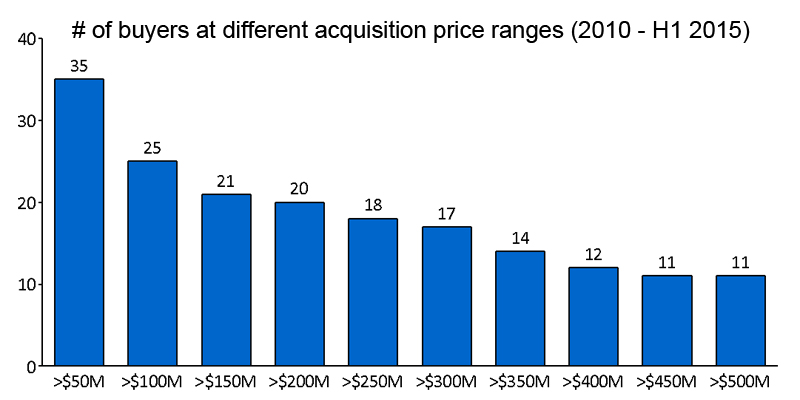
In the last three years, however, there have been a handful of successful EdTech IPOs including companies like 2U and Instructure. Others, such as Coursera, Udacity and Edmodo, are all not far behind in the IPO pipeline. M&A activity likewise has been quite strong. In fact, U.S. EdTech companies tend to command higher revenue multiples than the average tech exit—3.2x for EdTech companies vs. 2.5x for the broader tech industry. Furthermore, M&A exits themselves over the last 5 years have been fruitful with 25 buyers spending more than $100M on U.S. EdTech companies.

exits-1438648868.jpgSource: EdSurge

Yet despite this progress, there remain a wide array of inefficiencies and unsolved problems. Specifically, I see 6 promising near-term opportunities for entrepreneurs to take advantage of and for investors to invest in. In no particular order here are a few thoughts of what we will see beginning in 2016.

1) Cloud SaaS will finally replace on-prem at the school district and system admin level

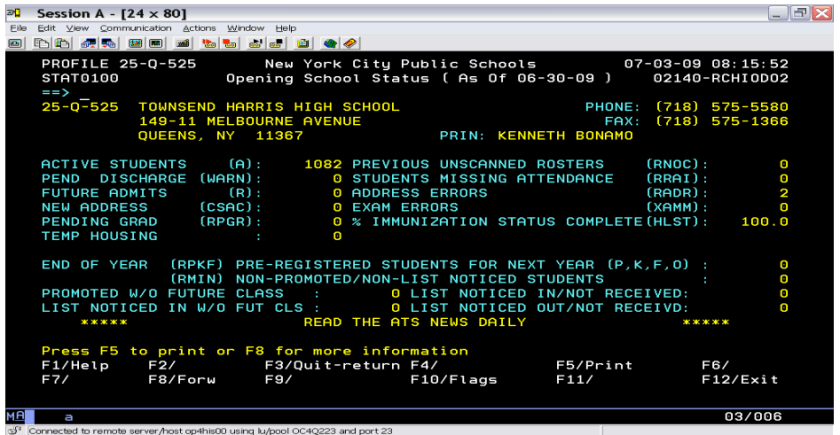
Having spent time working at the district level in education policy, I was always amazed at how archaic many of the tools districts and school systems use at the city-wide/admin level. Software tools that track important mission-critical information such as attendance, student demographics, building information, zone data, etc. across schools within a district are still often hosted on-premise, using archaic databases and outdated software with GUIs that look like they were designed in the ‘90s. Below is an example of what the NYC DOE ATS currently looks like:

Untitled.pngSource: NYC Department of Education

I suspect that in 2016, as much of the IaaS and PaaS layers begin/complete their moves to the cloud through services provided by the likes of AWS, Azure, SoftLayer, etc, we will begin to see more B2B SaaS applications layered on top to replace the traditional on-prem software solutions. This will bring much needed functionality, analytics and a cleaner user experience to the education world. This in turn will increase productivity for educators working at the district and administrative level across school systems.

2) Learning content will be far more personalized

Recent survey data showed that less than 50% of teachers reported having digital resources that could be used to meet teaching standards. Moreover existing technology solutions often are not tailored to individual students and their specific needs. The next generation of student-centric software tools (across grade levels and subjects) will provide high levels of granularity and insight into the specific needs of individual students allowing for an end-to-end customized experience across lesson planning/ delivery, class activities and periodic assessments. This will be even more important for special needs students in ICT, 12/6:1 or similar learning environments. Personalizing learning content will ultimately allow for a more tailored learning experience and better long-term knowledge retention.

3) K-12 teacher development will rely more heavily on software platforms and tools

As it stands today, professional development for teachers is largely untouched by software tools and applications. At the district level, spend on professional development for K-12 teachers in the U.S. is ~$3B and usually takes 1 of 4 forms: (1) periodic school-wide workshops, (2) observation of other teachers, (3) coaching (usually by a more experienced teacher) and (4) generic online research.

In 2016, we will begin to see more PD content move to the cloud as doing so makes training teachers: (a) less expensive, (b) more accessible and (c) more personalized. Horizontal HR solutions like Workday, Cornerstone OnDemand and PeopleSoft will be re-built / tailored for the education sector enabling professional development in education to be more sophisticated and effective.

4) Higher education software tools will focus more on degree completion  

As the Baby boomer generations’ offspring (Gen X) move beyond the college-age window, the college enrollment growth rate will begin to slow and the focus for many higher-education institutions, from a revenue perspective, will shift away from recruitment/ matriculation and towards retention/ graduation. As of 2012, ~50% of all college students were in at least 1 remediation course.

In the years ahead, there will be a greater focus on retention and remediation of students already admitted into colleges. Software tools will increasingly be used for (1) recruiting the right type of student to admit, (2) providing BI and predictive analytics platforms for identifying and tracking high at-risk students and (3) supporting remediation instruction for at-risk students to get them back “on track.”

5) Online courses and degrees will become more relevant

While online courses (including MOOCs) and degree programs will never replace the off-line experience, these offerings will increasingly be used to supplement off-line instruction as well as provide a new delivery format to non-traditional segments (such as continuing education students). Two important trends are happening that will accelerate the pace at which this happens in 2016: (1) online courses and degrees are becoming more socially acceptable (many programs have been accredited, employers are increasingly hiring graduates from these programs, etc.) and (2) the infrastructure (managing enrollment, handling payment, providing tech support, hosting platforms, etc.) to provide these offerings is cheaper and more readily available.

As such, we will see a greater number of higher education institutions join the ranks of UNC, USC, ASU and many others that provide courses and degrees online. This trend will create a range of software opportunities across: video collaboration, course development and delivery, student / faculty services and recruitment / retention.

6) Demand for software tools that teach skill-based training will increase  

As colleges increasingly charge exorbitant tuition fees while failing to equip graduates will real skills, demand for skill-based programs, vocational certifications and other alternative teaching tools will increase. In 2013, the number of vocational certificates granted was nearly 1M—up 35% from 2005. Similarly, from 2013 to 2015, the number of graduates who graduated from coding programs (such as Codecademy) increased 630%+.

In 2016, we will see an even greater emphasis on tools for skill-based training. Some of this will be purely software delivered via the cloud and some will be more hybrid: software mixed with in-person training. Companies like Lynda (acquired by LinkedIn), Udacity, General Assembly and Udemy have already made significant dents in this space. We will see much more of this in the upcoming year.

Venture Debt: An Alternative form of Financing

In the tech ecosystem, we often associate entrepreneurial financing almost exclusively with venture capital. As a result, most of the fundraising resources for entrepreneurs are geared around venture capital. Likewise much of the media attention in the startup financing world is focused on venture capital investments.

The reality, however, is that there are many different forms of financing beyond traditional venture capital financing. And the type of fundraising instrument used is as important as the quantity being raised and who it is raised from. There is quite a bit of information out there about raising from friends and family, angel investors, crowd funding platforms and several of the other more common sources of financing outside of venture capital. But there is very little information about financing a startup through debt.

As such, Brian Feinstein of Bessemer Venture Partners, Craig Netterfield of Columbia Lake Partners and I put together a white paper on venture debt, which was released last week. It’s meant to be a fairly comprehensive guide for entrepreneurs who are interested in exploring venture debt as a viable option. Feel free to check it out here and send us any questions as they arise.

Updated Resource Section

I recently updated my resource section to include a variety of papers and presentations I authored or co-authored while at Columbia Business School. As I was sorting through my hard drive and getting rid of old files, I realized that a lot of time and effort went into some of these and that someone, somewhere might find some of this information useful.

So I’ve uploaded some of these thought pieces under 3 different sections:

  • Investment Memos: This sections contains three different investment memos on Airbnb, Prosper and Starwood. The first two are focused on later stage venture / growth equity investments whereas the Starwood memo is more of a traditional Buy/Sell/Hold analyst report.
  • Roadmaps & Theses: The next three sections contain a set of VC style investment roadmaps from the two internships I did in venture. The first deck is a roadmap focused on wearable tech, specifically Google Glass, from my time at Gotham. The second deck is a playbook on vertical saas opportunities that I put together for BVP. The final paper is an initial viewpoint on the manufacturing software sector that I put together for BVP while doing a deep dive into the space.
  • White Paper & Thought Pieces: The final section is more or less a catchall for a few other pieces that I thought were interesting but didn’t naturally fit into the other two categories. This section contains an in-depth analysis on M&A activity in the tech sector and the resulting implications for venture investors. This section also includes a deck that very accurately projected iPhone sales for Apple in Q3 of 2014 before actual figures were announced. Both of these papers rely extensively on regression analysis and other statistical methods.

So there it is, a few resources that I thought were interesting. I’ll continue to add to this collection as the opportunity arises.

The Age of the Unicorn: Traits of Today’s Unicorns & Their Marriage to the IPO Market

A few days ago, Dan Primack and Erin Griffith from Fortune put out an article entitled “The Age of the Unicorn” along with a nice list of the 80+ unicorns currently in business. In addition to providing a working definition of the “unicorn” (essentially a pre-IPO tech startup that has reached a $1B market value), Primack and Griffith go on to describe some of the characteristics of today’s post-bubble unicorns and why these companies have become much more commonplace. I decided to spend a little time looking at their list and gathering a little bit more information on these companies.

The first trait worth noting about today’s unicorns has to do with their actual valuations. While the mean valuation of these companies is nearly ~4B, this average is heavily affected by a few of the upper outliers—companies like Xiaomi ($46B), Uber ($41B) and Palantir ($15B). There are only 8 “decacorns” (companies with a $10B+ valuation); the majority of these companies fall in the $1-2B range. In other works, the collection has a long tail of companies that are “just barely” above the unicorn threshold. Importantly, these valuations are all on paper. For the founders and investors involved, these numbers are largely irrelevant until there is an exit to provide liquidity to these valuations (more on this towards the end of the post.)

Another characteristic worth noting is when these companies were founded. The average company life of these unicorns is 8 years—not all that surprising until you consider the fact that many of these companies have been unicorns for several years before Fortune published this list. In fact, the speed with which some of these companies have reached unicorn status is unparalleled. 7 of the companies (~9%) were founded in the last 2 years and 31 (~40%) were founded in the 6 years since the financial crisis. A mere 12 unicorns (15%), are dot-com survivors (founded in 2001 or earlier).

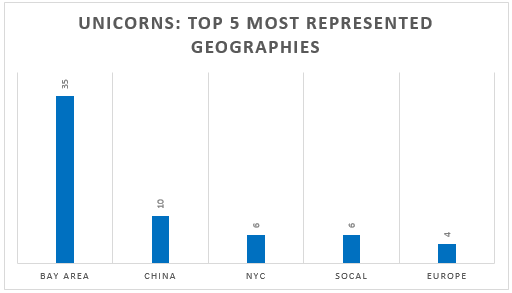
A final characteristic of the unicorn list worth noting is where they were founded. The chart below shows a story that is not all surprising—namely that the Bay Area is still King when it comes to producing fast-growing tech startups. That being said, the Bay Area’s “share” of unicorns, at 44%, is certainly not what it used to be. China is clearly a major force in the production of unicorns as is NYC and Europe. The surprise from a geographic perspective appears to be Southern California in 4th place—bolstered by the likes of SnapChat, SpaceX and JustFab. While not shown in the chart below, Boston and India are both tied for a close 6th with 3 unicorns each. Interestingly, each of India’s 3 unicorns are in the online retail/commerce space: FlibKart, SnapDeal and InstaCart.

unicorn location

There has been much debate on the drivers behind the growth in the number of unicorns, the macroeconomic implications of more privately held $1B+ companies and the possibility of a growing bubble. Griffith and Primack’s article provides a great overview of these debates and other related issues. One implication that is pretty evident, however, is that the IPO markets need to continue to stay strong in the next few years or venture investors are going to face disappointment. A quick example will help illustrate this point.

Let’s say you’re a VC who recently invested $100M into the latest round of a fast growing startup at a $900M pre thus providing the company with unicorn status based on its $1B post. As a VC, you’re looking for at least a 3x cash-on-cash return on this investment. In order for you to realize that type of return, the company you invested in needs to exit for at least $3B. Very few companies in the F500 can afford an acquisition of that size. Thus, in order to realize that kind of return, you will push the company (and its management team) to go for the IPO. This push for an IPO may be aligned with the founder’s goals but it may also come despite the attractiveness of an acquisition from the founder’s perspective. Even if there is full alignment on exit strategy, the whole thing will unravel if the IPO markets cool and there is no demand for these assets. Thus, the Age of the Unicorn is strongly tied to the strength of the IPO market. In the coming months, I think we’re going to hear a lot more speculation from the venture community on this very topic.


M&A Activity of Major Tech Companies

In the venture world, there are typically two ways VCs successfully exit the companies they invest in: (1) via IPO or (2) through acquisition by a larger tech company (think Google, Microsoft, etc.,). Of these two methods, an M&A exit has historically been more common. Nonetheless the literature within the venture community about why large tech firms acquire the specific targets they snap up is sparse. It seems odd that while ‘the acquisition’ is the main goal for most of the venture community, many VCs spend little to no time thinking about investing from the perspective of the firms doing all the acquiring.

This semester, I took Columbia Business School Professor Raul Katz‘s course on Developing Strategies for High Tech firms. In the process, I wrote my final paper on this very subject. The focus of the paper was to understand the recent (last 3 years) M&A activity of four of the largest global tech companies: Apple, Facebook, Google and Microsoft. Specifically the paper analyzed the implications the M&A activity of these four companies (and others like them) has for early stage VCs focused on investing in tech companies.

In building towards a hypothesis around the motivations for M&A activity, I examined the 7 motivational variables displayed in the table below. I focused solely on operational motivators and excluded non-value maximizing motivators such as management hubris or financial synergies like the desire to reduce the weighted average cost of capital (WACC). The rationale behind this focus is that operational synergies are the most relevant and identifiable variables for VCs to focus on as they think about M&A as an exit option. Operational synergies are also: specific, repetitive (allowing for pattern recognition), have predictive power and can be used to build an investment thesis.

The shaded rows represent new variables previously not looked at in the existing literature. I used S&P Capital IQ as well as a variety of analyst reports and news articles (VentureBeat, TechCrunch, etc.,) to populate the data used in the regression model.

Image

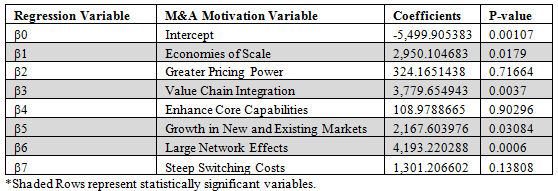
The results of the regression analysis are displayed below:

Premium Paid = -$5,500 + $2,950(β1) + $324(β2) + $3,780(β3) + $109(β4) + $2,168(β5) + $4,193(β6) + $1301(β7)

Image

There are several characteristics of the regression worth pointing out. First, the intercept (β0) is negative, which limits the full application of the regression equation. This is likely due to a small sample size and data that is not normally distributed. Because of this negative intercept, we cannot make a direct dollar connection between each M&A motivation variable and the premium paid by the acquiring firm. That being said, we can make some relative observations based on the size of each beta coefficient. Additionally we can make some important observations regarding statistical significance. As seen in the exhibit above the four M&A motivation variables that were statistically significant include: economies of scale, value chain integration, growth in new and existing markets and large network effects. The remaining three variables are not statistically significant according to our model.

The results can be broadly bucketed into B2C variables and B2B variables—although there is certainly some overlap. On the B2C front, unsurprisingly, tech firms like Apple, Facebook, Google and Microsoft place the largest premiums on startups with large network effects. Acquiring companies like Instagram, WhatsApp and Skype allows these firms to essentially acquire a massive customer base with a large customer life-time value. Because of the large network effects, these customers are unlikely to switch to substitutes. Big tech firms can then monetize these acquired customers over a long period of time as well as cross-sell products and services on their existing platforms.

According to our regression output, these big tech firms also place an important (though not nearly as large) premium on B2C companies that allow them to grow in new and existing markets. B2C companies like Snaptu (a mobile platform for feature phones in developing nations acquired for $70 million) and Oculus VR (a virtual reality and gaming device company acquired for $2.3 billion) allow big companies like Facebook to enter new markets—whether geographic, customer-segment specific or newly emerging industries.

When it comes to B2B acquisitions, the M&A model provides evidence that large tech companies place a heavy premium on value chain integration and economies of scale—both means to maintain a competitive advantage. Apple’s acquisition of semiconductor company Anobit Technologies for $400 million is a great example of value chain integration. Apple has slowly been moving away from hard drives to flash memory beginning with the iPod and most recently its MacBook Air. Flash memory allows Apple’s products to be thinner and run on less power. Acquiring Anobit allowed the firm to acquire the hardware component needed to complete value chain integration and transition fully from hard drives to flash memory chips.

Though not as important as value chain integration from a relative perspective, large tech companies also consider economies of scale when acquiring B2B companies. Within that realm, companies that provide a service or toolkit that enable a bigger tech company to take advantage of scale economies are also often worth acquiring. Microsoft’s acquisition of Pando, a file-sharing technology that works peer-to-peer like bit-torrent, is a great example of this. Pando’s technology can be applied to Microsoft products like Xbox and Windows Phone App Store, to reduce costs in these divisions and enable Microsoft to take advantage of its economies of scale.

For full analysis of the results of this study as well as a discussion of the implications for VCs, please email the author.

Google Glass Investment Thesis

About a year ago, I wrote a post about Google Glass and the possibility that Glass (and other wearable tech hardware platforms) would eventually give rise to the next generation of startups. It seems like the jury is still out on whether Glass will be the next iPhone, but it is certainly an area worth exploring further. This semester while interning with DFJ Gotham Ventures, I was charged with building out an investment thesis around the Glass ecosystem.

As a result, I did a deep dive analysis on the eyeware itself, the wearable tech industry more broadly speaking and the opportunities and challenges that currently exist for venture investors. In the process, I went as granular as focusing on specific industries and identifying companies within those industries. I was fortunate to speak with a wide range of VCs, entrepreneurs and industry experts – all of whom greatly contributed to the end product. Special thanks to Zak and Lucas on the Gotham team and Professor R.A. Farrokhnia for their guidance. Enjoy and feel free to drop me a line if you have any comments or suggestions.