
Core & Emerging Platforms as we Move into 2017

Innovation at the platform level (whether it be improved hardware, changes in infrastructure or new ecosystems) has always led to new opportunity at the application level for both entrepreneurs and the investors that back them. As 2016 winds down and we look ahead to 2017, it’s as good a time as any to take stock of the innovation we’ve seen at the platform level in the last few years and the trends in tech that will drive new opportunity in application software.

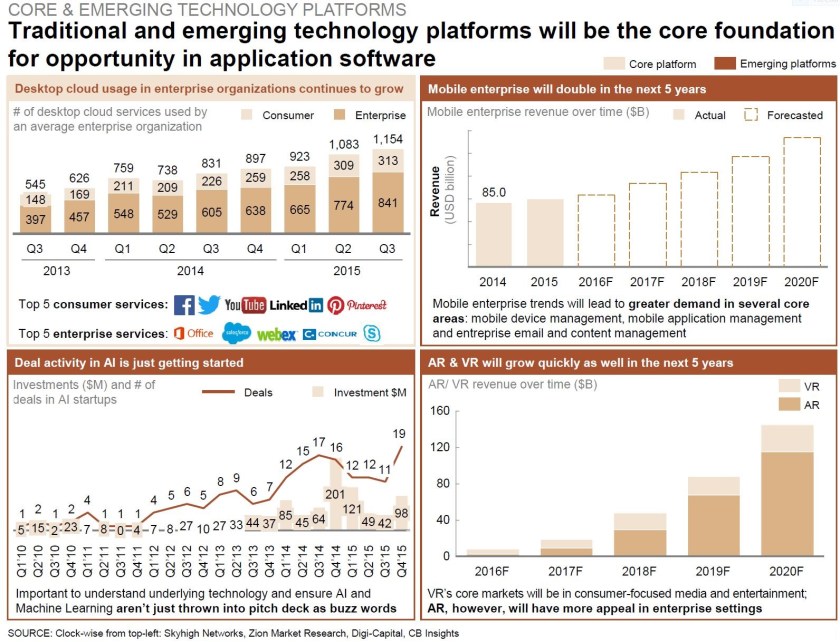
More specifically, I see four core and emerging trends that will continue to dictate opportunity in B2B software: (1) continued dominance of cloud, (2) acceleration of mobile enterprise, (3) increased attention to AI (more specifically machine learning) and (4) the rise of AR & VR – particularly AR in the B2B setting. The figure below provides an overview that will be explained in further detail below:
tech-platforms

(1) Continued dominance of cloud

This is an “old” one but a good one. Of the four platform trends this is the most established one and has produced the most opportunity to-date.

From a horizontal perspective, the cloud has penetrated (though not yet dominated) every function within the enterprise. Salesforce is the prevalent choice for most in the sales / CRM functions. Companies like Workday, Cornerstone and SuccessFactors have gained real traction within HR. Eloqua, ExactTarget and Marketo are widely used marketing tools. NetSuite has a strong presence in ERP while Zendesk is a strong force in customer success. And there are many other more recent horizontal SaaS companies that have made big waves: Slack, Stripe, DocuSign and DropBox are just a few of many that had big years in 2016. And there are many more opportunities remaining in relatively untouched areas like: sales ops, SMB-focused HR tools, inventory management, market intelligence and customer care analytics.

Vertical software, is still very much in its infancy. There have certainly been some early winners like Veeva (life sciences), RealPage (real estate) and Fleetmatics (fleet management), but there are many more industry cloud winners to come. Industries like manufacturing, construction, logistics, agriculture, oil and gas and others have slowly begun moving to the cloud after remaining cloud-allergic for many years. 2017 will be a big year for many of these industries and the vertical-focused, category-winners that reshape them.

(2) Acceleration of mobile enterprise

Aggregate mobile enterprise revenue in 2016 was just under $100B –pretty solid for a platform that didn’t exist 10 years ago. However, this one is also just getting started. Forecasts show this number doubling by 2020 (and I wouldn’t be surprised if the growth rate is higher than that). Part of this growth is fueled by increased vertical software opportunities. Procore is a great example of a company delivering a vertical specific solution (in construction) via mobile enterprise. Industries like education, insurance and real-estate will soon follow.

(3) Increased attention to AI  

2016 really marked THE year when AI (or more accurately, machine learning) really came into focus in the startup and venture community. As seen in the figure above, deals done and investment dollars poured into the sector have grown exponentially in the last 2-3 years. In that time, AI has done a few interesting things:

  • It has re-opened the door in a real way to more horizontal software opportunities giving rise to the “disruption of the disruptors.” Suddenly, machine intelligence has allowed for greater insights and better products and services that opened the door to new entrants looking to enter horizontal spaces.
  • It has allowed for more focused solutions that really benefit from machine learning applied to large data sets to flourish. Little Bird (a market intelligence and data analytics company based out of Oregon) that was recently acquired by Sprinklr is a good example. AI powered point solutions like Little Bird, once bolted onto larger platforms (like Sprinklr’s social media management platform) can exponentially increase the utility to their enterprise customers.
  • It has brought back IBM’s relevance among innovators and early stage companies. Ironically, rightly or wrongly, IBM’s Watson is the most common machine associated with machine learning. Whether IBM is able to harness the potential of AI remains to be seen, but the company attempts to be mounting a bigger challenge to be a dominant presence in the space rather than giving way to the big four (Apple, Facebook, Amazon and Google) as it did with consumer devices, social, ecommerce and search.

Expect AI to be a powerful trend in 2017 and beyond, with both startups and established players getting involved, especially as the technological innovation becomes more advanced.

(4) The rise of AR & VR

AR and VR are the furthest off in terms of real platform potential and 2016 was largely a pretty big disappointment for these platforms. The biggest thing in AR/VR in 2016 was Pokémon Go, which was an entirely consumer play (and appears to largely have been a fad). I expect VR to still be a few years away from going mainstream –and even when it does, it will continue to be a consumer play.

That being said, I do think in 2017 we will see the start of some AR-based software applications that will gain traction among enterprises. And by 2020 forecasted revenues in AR will near $120B. Some of the important early verticals AR will start with will be healthcare, manufacturing, defense and architecture among others. Some of the early startups playing in these spaces, that I’ll be following in 2017 include: CrowdOptics, APX Labs and Pristine.
The Importance of Customer Success

A lot of the literature for startups and early stage companies focuses on revenue growth and customer acquisition. But over the last few years, customer success has begun to come into sharper focus, particularly given the movement to SaaS and cloud software, which naturally forces many software companies to think more seriously about customer success.

Nonetheless, churn benchmarks and insights on which metrics matter the most have often been hard to come by. Over the last few months, a few of us in McKinsey’s growth tech practice partnered with some leaders in the startup / venture ecosystem (thanks BCV & Gainsight!) to shed some light on the topic of customer success.

The results of this analysis, published here, were very interesting indeed!

Reassessing account coverage models in B2B Sales

Early stage B2B SaaS companies, and tech companies more broadly speaking, are typically very focused on adding new accounts, growing existing accounts (up-sell and cross-sell) and serving their account base as best they can (customer success). These activities drive revenue growth, which in turn drives valuation, market credibility, ability to hire talent and a whole host of other important things.

While this focus is certainly well placed, in the process of focusing on revenue generating activities, many B2B SaaS companies forget to periodically assess their accounts from a profitability perspective and ensure that their sales coverage models are appropriately positioned given the varying profitability of the underlying accounts being served. The result is that many of these B2B companies end up relying too heavily on large direct sales forces when:

  • The profitability of the underlying customer accounts doesn’t justify the use of direct sales reps in all situations
  • There are often lower cost to serve models that are not only cheaper but also more effective with many types of customers.

As such, if you rely heavily on a large direct sales team, it can often be helpful to do a quick coverage alignment exercise to determine whether it is worth re-assessing your account coverage model. While this is primarily a cost-saving activity (e.g. moving some accounts from a higher cost direct model to a lower cost indirect model) there can many times also be revenue-generating opportunities as well because many customers actually prefer non-direct sales channels.

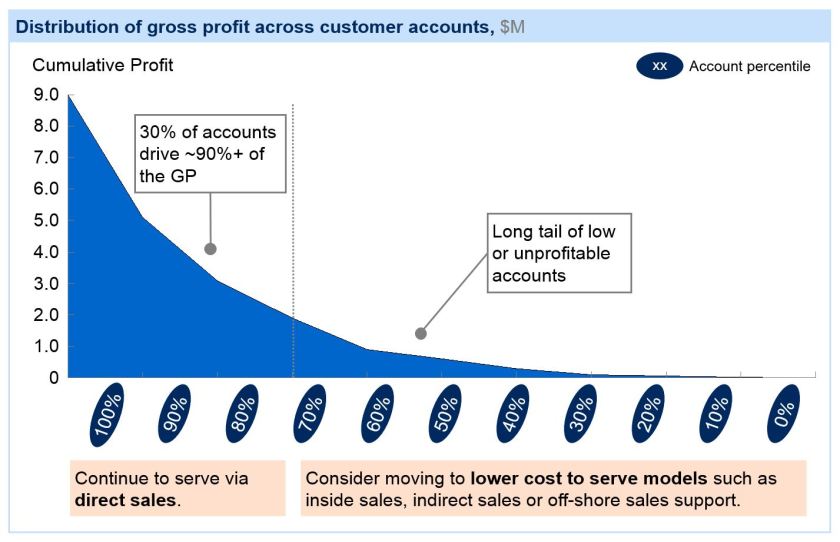
The first step to reassessing your account coverage model is to plot out the full distribution of all your customer accounts from a gross profit (not revenue) perspective. It is important to look at profitability and not revenue here as revenue alone will not help identify accounts that could be moved to different coverage models. Breaking out the distribution into deciles is often helpful in terms of bucketing accounts into different categories. Many B2B tech companies have a distribution that looks something like this:

Long Tail

As seen in the chart above, a minority of customer accounts are driving the vast majority of the gross profit. In this example, 30% of accounts are driving ~90% of the total GP. In most cases, it makes sense to continue to serve these high-value customers through a direct model. Losing these customers or serving them in a different way could be devastating.

That being said, there is also a long tail of low or even unprofitable accounts. For the most unprofitable accounts (e.g. very negative accounts), in some cases it may be better to simply stop serving these customers altogether because you are losing money on each one with no way to profitably serve the account.

For the “long tail” of customer accounts that are low profit or even slightly negative, this is where it is worth re-assessing your coverage model and thinking through other lower cost to serve options with the end goal of improving GP. There are at least 3 viable coverage options that could be used to improve the profitability of these accounts (and maybe even grow them).

(1) Inside sales: Inside sales reps come with less of the overhead and expenses that direct sales rep comes with. They have much lower (if any) travel, lodging and entertainments costs. Inside sales reps also tend to be cheaper and can have more flexible roles (i.e. as hunters, farmers, sales support, customer care, etc.)

(2) Channel: Indirect reps or channel partners can also be used to lower the cost to serve and improve account profitability. This go-to-market strategy can be more appealing to customers who are used to making purchases from a trusted channel partner. In addition to saving money on expensive direct sales reps, many of the same levers used to compensate direct sales reps (tiered commissions, accelerated payout above 100% quota attainment, etc.) can be used with indirect sales reps. If managed correctly, these compensation levers combined with the right channel partner could actually drive further top-line growth.

(3) Off-shoring sales support: Reducing the cost of sales support is another lever lowering the cost to serve. Sales support (e.g. admin functions, sales operations, product support, etc.) can often be handled in near-shore or far shore locations via virtual support at a fraction of the cost of on-shore resources. While this approach should be balanced with a need to serve customers well, many sales support activities (including some that are customer facing) can be handled in lower cost locations.

Grow fast or die slow: Why unicorns are staying private

In today’s world, technology companies worth more than $1 billion—and many worth $10 billion—have fewer reasons to go public than they did in the past. It’s a new paradigm shift that has really changed many of the dynamics in the startup community. A few of us in McKinsey’s High-Tech practice put together an article on the software IPO environment and the implications for founders and VCs. We hope it’s an insightful read.

The full article is available here.