
Back East

I’ve moved back to NYC! To be more specific, the suburbs of NYC — but I think that still counts!

When Liza and I found out early last year that we were expecting a girl we knew we would have to make a decision about staying in the Bay Area or moving back east. After a bunch of conversations, we made the move in late February and have been settling in much more smoothly than I had expected.

With some time now to reflect, I’ve been thinking a ton about the differences between the two cities. For reference, I spent ~6 years in NYC (Brooklyn and Manhattan) and then ~6 years in SF. So I feel like I can credibly claim to have somewhat of a balanced view on the “great debate” of which is better. Unsurprisingly, as with many things, the truth is…it depends.


Much has been written of course about the demise of SF — homelessness, drug abuse, crime, commercial vacancies, etc. All of this is true and all of it quite sad. Each year I was in SF was more or less worse than the prior year, accelerated by the pandemic in a way that was hard to fathom at the time. But since I left, and have had some space to reflect, I find myself rooting for SF to make a comeback. And I think it will. The reality is, even now, there is no place on earth that has done more to advance technology and innovation than that ~50 miles between San Jose and the Golden Gate bridge. The talent network effects there run deep. The “builder mindset” second to none. And there are enough people still there who deeply care about the city and bringing it back to where it ought to be.

When I first started in venture in 2017 in SF, it was pretty common to take every first meeting with a founder in person. Some of my fondest memories of SF come from the hours spent walking all over Jackson Square, SOMA, FiDi and South Park between meetings to unearth opportunities. Back then the entrepreneurial community was so incredibly concentrated in a few of these neighborhoods that you could meet 50–75% of founders within a 20 min walk of Market St. There was something quaint, almost familial about the whole thing.

Of course the pandemic and ensuing years have broadened access beyond the Bay Area. And that is a very good thing as innovation should never be isolated to one area nor founders unable to access capital and resources purely based on where they live. Still, there is something very special about SF…not to mention it’s a city of immense natural beauty.


Everyone I know who left SF the last few years did so largely for “push” reasons. For us, there was certainly some of that. But deciding to move back to the NYC area had much more to do with personal “pull factors” than anything else: it’s the center of gravity for my wife’s side of the family (hooray for free child care!), the schools here are excellent, we’ve found there to be a strong sense of community, etc. And much of this is simply a stage of life thing. Having a child changed our outlook, including what we started to optimize for on location.


I’ve now been back in NYC for a little over 2 months. It’s been fun re-acclimating. As a fintech-focused investor, NYC is very clearly emerging as THE winner in financial services innovation. It’s not bigger than SF just yet in terms of outcomes, but the slope of the line, as defined by fintech startup formation and pace of growth, is incredibly steep.

When I first moved here more than 10 years ago, there was effectively one fintech company in the city that had some buzz: Betterment. There are now dozens of other examples and more forming each month. Many fintech founders are relocating from SF to NYC (or opening up a second office here). This week there are 3 major fintech-related conferences happening at the same time. It’s pretty wild.

Suffice to say I’m excited to get plugged back in here, reconnect with some old friends and make a few new ones. Looking forward to saying “hi” if you’re in the area.
Airbnb and the Problem with Later Stage Investing in Today’s Environment

A couple of months ago several news sources reported that Airbnb was raising $1B at a $20B (pre-money) valuation. This article on TechCrunch sums up the story pretty well.

I have a lot of respect for Airbnb as a business and the tremendous growth of the company in just 7 years. Airbnb currently boasts 1M+ listings across 34,000 cities and 190 countries. Though still a private company, revenue estimates for 2014 were said to be over $400M w/ yoy growth of 65%. Not bad for a company many famously passed on (including Fred Wilson) or wrote off as completely absurd. I’m confident the founders and early investors will be handsomely rewarded when the company eventually goes public.

I do, however, have concerns with the current massive round that Airbnb is raising. And it’s a concern I believe should be shared by many of today’s unicorns and, in particular, their later stage investors. If I were a prospective later stage investor in Airbnb’s $1B round, I would not invest at this stage and at that valuation. My thoughts can be summed up in three points:

  • A $20B valuation overinflates the true value of the business, which by my analysis is closer to ~$10.2B. This high private valuation will hinder returns for later stage investors—it’s a problem I think many of today’s later stage investors in unicorns are going to face. The infographic in this Forbes article shows a similar story with one of the more recent unicorns to go public: Box.
  • Airbnb has important competitive advantages in terms of network effects and customer captivity—they may even have a bit of a regulatory advantage thanks to their scale. The problem is that Airbnb has nothing that will allow it to be a complete “winner-takes-all” business. At the very least, it will have to share TAM with its most direct competitor, HomeAway, not to mention all the major hotel chains that have been around for decades.
  • There are a number of unknowns that make Airbnb a risky business to invest in including: macro-economic tourism and vacation trends, the decentralized nature of regulation and an uncertain cost structure that is likely to erode margins. Some of these unknowns could be very detrimental to Airbnb’s growth and continued success as a business.

For a more in-depth analysis of the investment opportunity, I’ve put together an investment recommendation deck below:

Travel & Transportation Ecosystem

The history and evolution of the travel and transportation industry is really quite fascinating. How we arrived at today’s mix of companies (both the incumbents and insurgents) is a story of technological innovation, savvy business positioning and a macro trend around increased travel and connectivity.

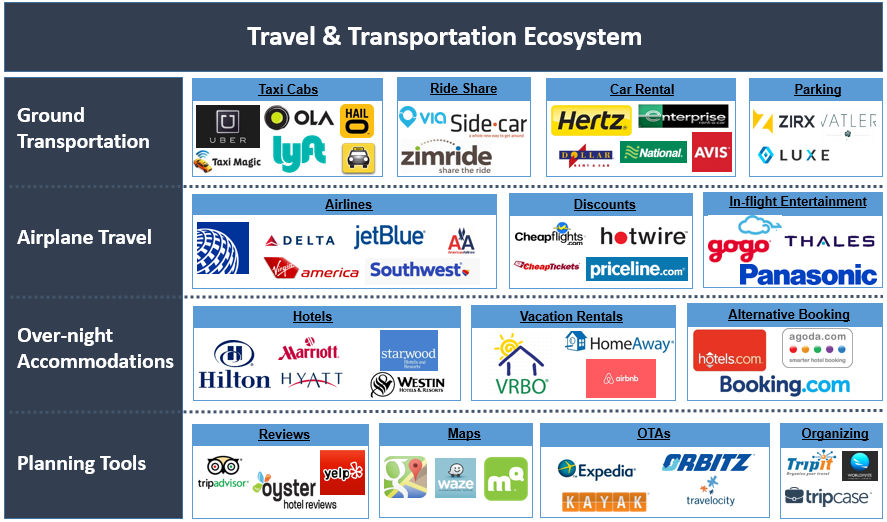
In today’s world, the range of different companies is quite impressive. On one end of the spectrum, you have the traditional, asset-heavy giants. In airlines there is United, Delta, American Airlines and many more. In hotels, Starwood, Hilton, Hyatt, and others dominate the scene. And in car rentals, Hertz, Avis, Enterprise and others have long been staples of ground transportation. Seeing the challenges that lie ahead, many of these travel/transportation behemoths are moving towards an asset-light approach and beefing up their digital and mobile offerings. Starwood for example has sold off nearly 85% of its properties in the last decade. They are moving more towards an approach that relies increasingly on a franchise / management fee model. Similarly Starwood has also invested heavily in their mobile app, which has paid off. In recent years, mobile bookings have increased 300% yoy and mobile revenue is a growing portion of total revenue.

In addition to the traditional players, you also have the .com darlings of the late 90s and early 2000s. These companies are particularly well represented among the OTAs. Oribitz and Expedia for example rose to prominence by helping consumers find and compare various booking options across the various legs of their vacation journey. Many of these companies have gone on to do quite well—though increasing competition has threatened earnings and growth. In addition to the OTAs, travel discount sites (such as Priceline) and review sites (such as Trip Advisor) were also largely born during this era and continue to do quite well.

Finally, there are the emerging companies of today that have successfully taken advantage of increased mobile connectivity, macro trends around the shared economy and advances is geo-location technology. In the taxi cab world, Uber, Lyft and others have built unicorn valuations in eye-popping speed. In vacation rentals, HomeAway and Airbnb are leading the charge to provide sellers with liquidity and renters with cost-effective options in those two-sided markets. And in mapping, Google Maps and Waze (acquired by Google), have greatly enhanced mapping capability. Not to mention the rise of ride sharing companies (Via, Sidecar, etc.) and parking services (Luxe, Zirx, etc.) which are just getting started. In the coming years, vertical cloud saas companies will only further enhance the options that consumers have today.

All in all, it’s a really interesting time to be in travel and transportation. I’ve put together a map of the travel and transportation ecosystem below. It’s certainly not all-comprehensive by any means, but it provides a general overview of these various players and trends. Hopefully it’s a useful guide to navigating the various sub-categories and players in the industry.

Travel & Transportation Ecosystem